There is a place where the path ends and the forest begins. For those who live among walls, fences and boundaries, it is the edge of the known world. Beyond it lies a landscape that follows different laws: a place of hunger and abundance, birth and death, silence and pursuit. The wolf belongs to that boundary. It resembles the animal that came to share our fires, yet it remains beyond their light. It knows the paths of the forest but owes them to no one. It can move close to the human world without becoming part of it. The surviving stories do not give us a simple ancient doctrine in which the wolf means only courage, loyalty or protection. They offer something more interesting. Again and again the wolf appears where boundaries become uncertain: between wilderness and settlement, animal and human, hunter and hunted, danger and protection. The wolf is therefore not the image of a single quality. It is the image of a threshold. A note on sources. When we speak here of a “Celtic” wolf tradition, we rely above all on Irish sources. Most of them were written down by Christian scribes in the Middle Ages, preserving older material that had passed through many hands. This is not a single system of belief but a mosaic of stories, names, language and folklore. Yet from that mosaic a remarkably consistent picture emerges.
The Wolf in a Real Landscape
Before the wolf becomes a symbol, we must remember that it was first of all an animal: a large predator that shared forests, mountain slopes and the edges of pastures with people. It hunted, scavenged and competed for prey. It could inspire fear precisely because its strength was real. In Ireland it remained a reality for a remarkably long time. The last wild wolf in Ireland is said to have been killed near Mount Leinster in 1786, roughly three centuries after wolves vanished from England and about a century after they disappeared from Scotland. The annals record wolves attacking people, for example under the years 1137 and 1420, and in the seventeenth century Ireland is reported to have been nicknamed “wolf-land”. Deforestation, bounties and organised hunting brought the wolf down, and Cromwell’s government paid rewards for wolves and banned the export of Irish wolfhounds (see Hickey’s study of the wolf’s extermination ). The stories about the wolf were not told far from the animal. They were told in a country where people genuinely feared for their sheep and children. The old tales preserve something of that unease. In The Destruction of Da Derga’s Hostel , the wounded warrior Mac Cácht lies on the battlefield and feels something nipping at his wound. He takes it for a fly, a gnat or an ant. It turns out to be a hairy wolf, buried in the wound up to its shoulders. A woman drags it out by the tail and Mac Cácht kills it with a single blow to the forehead. There is nothing gentle or romantic about the scene. The wolf belongs to a world in which survival has teeth. The modern Druid writer John Michael Greer makes a useful observation: the natural world should not be romanticised. Animals live within cycles of struggle, predation and death as surely as they live within cycles of birth and renewal. This matters. A symbol loses depth when we remove everything from it that can disturb us. The wolf is not powerful because it is harmless. It is powerful because its calm contains the possibility of attack. I don’t need to attack for you to know that I can.
Son of the Land, Wild Hound
Irish preserves several names for the wolf, and each says something different. One of the most evocative is mac tíre , literally “son of the land” or “son of the country”. It is attested in early literature and still lives in modern dialects, especially in Ulster ( Hughes, 2012 ). There is also cú allaidh , “wild hound”, and the older Irish fáel, represented by modern Irish faol. Faol also survives in personal names such as Faolán, “little wolf”. In Welsh the wolf is blaidd , and its trace can be heard in the name Bleddyn. The wolf is written on the map of Ireland, too. Toom, just east of Enniscorthy in County Wexford, was clearly Tuaim na Mac Tíre , “the mound of the wolves”, and there are many more such names (
- Logainm, the Placenames Database of Ireland ). The wolf is thus not merely an animal living in the land. It is the land’s son. It does not pass through the landscape as a visitor. It belongs to it in a way that a human being can never belong completely. Language does not prove a single religious meaning for the animal. It tells us something subtler. The wolf was close enough to human imagination to become part of the speech through which people named animals, landscape and eventually one another. Notice, too, how often wolf and hound overlap. The greatest of the Irish heroes is called Cú Chulainn, “the Hound of Culann”, and one of the names for the wolf is itself a kind of hound, cú allaidh . The line between dog and wolf is permeable in these stories, like so many others.
The Hunter, the Fían and the Hound on the Border
The wolf naturally belongs to the world of the hunt. The tales of Fionn mac Cumhaill and the Fíanna repeatedly lead away from settlements into forests, mountains and hunting grounds. The fían was not merely a poet’s fantasy but a real social institution: a band of free-born young men who, in the definition associated with
- Kim McCone’s work, had left fosterage but had not yet inherited the land needed to settle down as full members of the túath . For much of the year they lived in the wild, hunting and raiding. Irish literature often gives warriors canine or wolfish traits, from ferocity and unpredictability to a wild, dishevelled or naked appearance, and scholars have compared the fían with the young warrior-bands of other Indo-European societies, in which hound and wolf imagery plays a part. To this world belong Fionn’s famous companions Bran and Sceolang . They are usually understood as extraordinary hunting hounds, and some English translations call them wolf-dogs . It would be tempting to turn them simply into “Fionn’s wolves” and build a convenient mythology around them. The sources are more complicated. Their meaning lies precisely in the space between wolf and dog. The dog took to the human. The wolf stayed with the land that raised it. The hunting hound stands between them: a partner of humans that still carries the strength of the forest, of scent, pursuit and blood.
The King Who Kept Wolves as Hostages
Yet the most remarkable wolf scene in Irish literature is not a scene of combat. It is a scene of agreement. The same tale, The Destruction of Da Derga’s Hostel , describes the golden age of King Conaire’s reign. Under him, it says, wolves attacked only one bull-calf from each cowshed, and to keep that rule the king held seven wolves as hostages by the side wall of his house. Read that slowly. The wolf is neither exterminated nor tamed. It is a party to a treaty. The wild receives its share, one calf from each byre, and in return respects the boundary. The just king is not the one who drove out the forest, but the one who knows how to make peace with it. The story has a darker side. Conaire’s foster-brothers lead a band of young nobles who, in Whitley Stokes’s translation, were “were-wolfing” in Connacht. When they are caught, the king spares them death and sends them into exile, which leads to his downfall. The wolf within the treaty protects the peace. The wolf outside it destroys it.
The Morrígan as a She-Wolf
One of the clearest appearances of the wolf in medieval Irish literature is in the
-
Táin Bú Cúailnge . In Lucy Faraday’s translation, Cú Chulainn is fighting at the fords, and the Morrígan, spurned by him, threatens to interfere in his combats: first as an eel that trips him, then as a grey she-wolf that drives cattle onto the ford, and finally as a hornless red heifer leading the herd. Cú Chulainn wounds her in every form and still wins the fight. (Details of the sequence vary between recensions of the Táin.) The she-wolf here is no calm guardian of the forest. She is disruption: driven cattle, muddied water, lost footing. The wolf is neither mascot nor spirit companion. It is power made animal. And the story does not end in enmity. The Morrígan later appears to him as an old woman bearing wounds that match those of her animal forms. She offers him three drinks of milk, and with each he blesses her and her wounds are healed. The same being who stood against him as a wolf turns out to be someone who can be blessed and healed. In the
-
Táin Bú Regamna she tells him that she will guard his death. That, too, is one of the faces of a guardian: the one who stands at the boundary between life and death. For a tradition so often reduced today to lists of positive symbolic qualities, this ambiguity matters. The old stories rarely behave so neatly. Their animals can protect and destroy. Their gods can bless and threaten. The wild is not evil, but neither is it obliged to be safe.
The Wolf Mother: A King Raised in a Cave
Irish tradition also knows a wolf that does not merely spare a child, but raises one. The birth-tales of Cormac mac Airt, the legendary High King of Ireland, say that as an infant he was carried off by a she-wolf and reared among wolves before he was rescued. These traditions,
- Scíla óogain ocus Cormaic and Genemuin Chormaic , edited by Tomás Ó Cathasaigh, are early medieval: the language of one version is dated to about the eighth century, that of the other to the tenth. Scholars point out that the story follows the pattern of a “heroic biography”: abduction, suckling and rescue of the boy ( McCone, 2024 ). A Roman reader will think of Romulus and Remus. Local tradition ties the story to the Caves of Kesh in County Sligo, and Sligo folklore recorded in the Schools’ Collection adds vivid details of its own: seven years among the wolves, a child who could only growl, spoke the language of wolves and moved on all fours ( Dúchas ). These details belong to folklore rather than to the early texts. Notice what kind of king emerges from this cave. He is the man who will later gather the country together from Tara. But first he had to learn the language of the wild. A ruler who wants to hold a boundary justly must know both sides of it.
When the Human Becomes the Wolf
In medieval Irish tradition there is an even stranger boundary: the boundary between wolf and human. Stories connected with Ossory preserve traditions of people who take the form of wolves. The motif is strong enough to have become a subject of scholarship in its own right, including John Carey’s study Werewolves in Medieval Ireland . Its best-known form was given by
-
Gerald of Wales in the late twelfth century ( the priest and the werewolves ). A priest travelling from Ulster into Meath meets a talking wolf, who turns out to be a man of Ossory. His ancestors had been cursed to become wolves every seven years. The wolf begs the priest to give the last rites to his dying wife, and afterwards, in gratitude, sets the priest on the right road. The
-
Annals of the Four Masters, under the year 690, likewise record that in Leinster a wolf was heard speaking with a human voice, to the horror of all ( Annals ). The details vary between sources, and later Christian writers interpreted older material through their own worldview of curse and sin. But the persistence of the motif matters. The wolf is not always something encountered outside the human world. Sometimes the human crosses the boundary. The wilderness is then no longer merely a place beyond the settlement. Something of it can exist within us. A person may wear the skin of civilisation and still listen to the forest beneath it. Perhaps that is one reason the wolf remains so powerful an image today.
Predator and Protector: Wolves and Saints
Irish tradition also allows the relationship to reverse. In the
- Life of Saint Abbón of Moyarney, a wolf appears twice. As a boy, Abbón is watching his foster-mother’s calves when a wolf comes to him. He tells it to eat one of the calves because it is hungry. When the other boys complain, he restores the calf by prayer. The scene strikingly echoes the pattern we saw in Conaire’s house: once again, the wolf receives its calf. Later, when Abbón’s shepherds see wolves approaching the flock, the saint commands that they be left alone, and the wolves become his shepherds for as long as he lives. Nothing suggests that the hagiographer knew Conaire’s tale; the resemblance is our reading, not a documented link. The motif is not isolated. Wolves act as herders in the Lives of Saint Fintan and Saint Brigit ( overview of wolves in hagiography ). And Saint Ailbe of Emly, patron of Munster, was according to legend abandoned in the forest as an infant and nursed by a she-wolf. Years later, when he was a bishop and hunters were chasing an old she-wolf, he protected her, and she and her cubs came each day to eat in his hall. This is Christian literature rather than evidence of an ancient Druid teaching, and it should be read as such. But it belongs to the continuing Irish imagination of the wolf and reveals something remarkable about the symbol. Scholars note that in hagiography the role of wolves is overwhelmingly negative, and that the more ambiguous tales, in which wolves are fed, spared or put to work, are a minority, many of them Irish. Hagiographers could present such scenes as a return to paradisal order, in which the saint’s holiness reconciles predator and flock, and some of these wolves may in fact have been feral sheepdogs ( Animaliter ). Danger and guardianship are not necessarily opposites. The creature that can cross the boundary can also guard it. The teeth remain the same. Only their purpose changes.
What Did the Wolf Mean to the Celts?
The temptation is to give a simple answer: strength, loyalty, intuition, courage, protection. Such lists are common in modern writing about Celtic symbolism. The surviving evidence does not justify reducing the wolf to them. We have fragments of mythology, medieval literature written down in societies that had already changed profoundly, archaeology, place names, language, folklore and later Romantic and neo-Druid interpretations. We do not possess an ancient Druid handbook telling us that the wolf represented five particular qualities. A historical source can show us where and how the wolf appeared. It does not automatically follow that every modern meaning was part of the original belief. It helps to separate two questions. The first: What can we document about the wolf in historical and literary sources? The second: What can the wolf mean to a person today? The first is answered by texts, language and the history of the land. The second belongs to personal experience, modern Druid practice and creative work with symbols. The two can meet, as long as we do not confuse them. Modern Druidry itself offers a useful warning. Greer openly distinguishes historical material from symbolism developed by the Druid Revival and modern practitioners. Even within his treatment of Ogham, he identifies which associations come from older Irish texts and which animal, calendrical, elemental and divinatory correspondences are later additions. This does not make modern symbolism meaningless. It makes its origin clear. A living tradition does not have to pretend that every new branch is an ancient root. Greer describes Druidry itself as something that continues to grow and change, and warns against treating any single modern book as infallible. For him, the ultimate teacher is nature. So perhaps the second question is best asked not as What did the wolf mean? but as What can the wolf teach us?
The Guardian at the Boundary
This is where historical tradition ends and my own interpretation begins. In my work, the wolf becomes a guardian. Not because I have found an ancient text declaring the wolf a Celtic symbol of protection. I have found no surviving ancient text that says so. But I have found something else that gives the interpretation ground to stand on. A wolf that becomes the shepherd of a flock. Wolves that sit as hostages by a king’s wall, their presence holding the peace. A she-wolf who raises a future king. These stories are not a doctrine of protection, but together they form a pattern. The meaning comes from the place the wolf occupies. At the boundary. Between the path and the forest. Between the fire and the darkness beyond it. Between what has accepted human order and what remains wild. Between animal and human in stories where one can become the other. A guardian must understand both sides of the threshold. It cannot belong only to the world of order. To guard the edge of the forest it must know the forest. And it must possess something more than kindness. It must be capable of saying no. The wolf does not need to attack everything that approaches. It watches. It listens. It knows its territory. It conserves its strength. But the possibility of that strength is always present. Without that possibility, there is no protection.
The Wild Within
A boundary need not be only a fence, a gate or the edge of a forest. It can be inner: between rest and exhaustion, between helping others and denying oneself, between openness and exposure to what we can no longer bear. In this the wolf is a reminder that a boundary is not hostility. To protect your space does not mean hating the world beyond it. It means recognising what belongs inside and what does not. The wolf does not say: Everything beyond the boundary is an enemy. It says: Notice what is approaching. Its wildness need not mean chaos. It can stand for the part of a person that responds before everything has been explained by reason: it notices a change in a voice, in a movement, in the atmosphere of a room, and picks up a tension that does not yet have a name. To work with the wolf can therefore be a return to instinct, to the body and to the land. We learn to listen to our own boundaries, to tell real danger from needless fear, and to accept the part of ourselves that cannot be entirely tamed.
Wolf Guardian: Wood at the Threshold
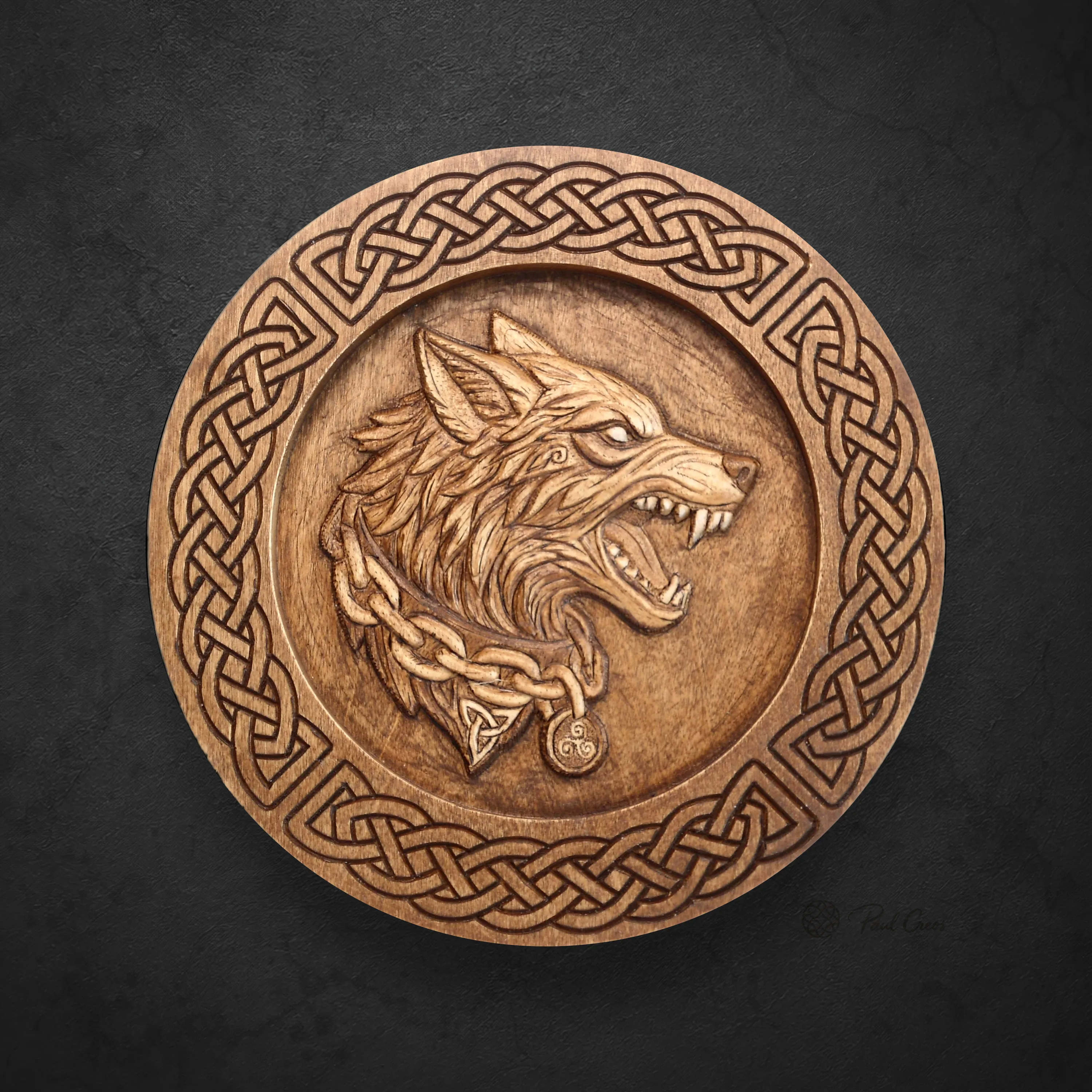
The Wolf Guardian roundels grew from this interpretation. They are not reproductions of an archaeological original, nor a claim that historical Druids used precisely this image. This is contemporary work, drawing on older stories, experience of nature and personal symbolism. Each is made as an individual work rather than as a reproduction of an identical design. The wolf remains recognisable, but the wood, the grain, the surface, the details and the character of every piece are allowed to become their own. One may look calm and still; another may carry tension in its eyes and ears tuned to a sound from the forest. Wood is a natural material for such a symbol. It comes from a tree that itself stood between worlds: between roots below the earth, a trunk in the human realm and a crown exposed to wind and light. When it becomes a guardian, it need not lose its memory. It can reveal it. Each guardian therefore belongs to a particular threshold: a doorway, a garden, a place of quiet, the beginning of a new stage of life. And, eventually, to a particular keeper. I believe that when a work is created with a clean intention, a connection already begins to exist between it and the person who will one day keep it. The meeting simply has not happened yet.
Conclusion: The Guardian at Your Boundary
The wolf is one of those beings that cannot be fully domesticated. In Irish tradition we find it as a real predator, a son of the land, a companion of the hunter, the shape of a goddess, an image of transformation, a cursed human, a hostage under treaty and a shepherd of the flock. Its meaning cannot be closed into a single word, and that is exactly why it stays alive. This is the wolf I carve. Not an emblem of aggression, and not a domesticated image of loyalty. A presence at the boundary. Watchful. Wild. Still. Somewhere between the known path and the wild country beyond it, two paths eventually cross. The path of the wood, and the path of the person who will keep it. And the guardian takes its place. May the wolf at your boundary know what should be welcomed, what should pass, and what must go no further.
Sources and Further Reading
Primary texts
-
Togail Bruidne Dá Derga (The Destruction of Da Derga’s Hostel), trans. Whitley Stokes. CELT, University College Cork. https://celt.ucc.ie/document/T301017A
-
Táin Bú Cúailnge, the Morrígan’s conversation with Cú Chulainn, trans. Lucy Winifred Faraday. Cartlann. https://cartlann.org/the-conversation-of-the-morrigan-with-cu-chulainn/
-
Scíla óigfhir ocus Cormaic and Genemuin Chormaic, ed. Tomás Ó Cathasaigh, The Heroic Biography of Cormac mac Airt (Dublin, 1977).
-
Life of Saint Abbán , in Charles Plummer, Bethada Náem nórenn (Lives of Irish Saints), 1922. CELT. https://celt.ucc.ie/document/T201000G/
-
Vita sancti Albei (Ailbe of Emly), in Charles Plummer, Vitae Sanctorum Hiberniae (Oxford, 1910); cf. W. W. Heist, Vitae Sanctorum Hiberniae ex codice olim Salmanticensi (Brussels, 1965).
-
Annals of the Four Masters (entry for 690). CELT. https://celt.ucc.ie/published/T100005A/text052.html
-
Gerald of Wales, Topographia Hibernica (the priest and the werewolves of Ossory). http://www.luminarium.org/mythology/ireland/werewolves.htm
Studies and background
-
Kieran Hickey, “A Geographical Perspective on the Decline and Extermination of the Irish Wolf” (archived). https://web.archive.org/web/20120907043329/http://www.ucd.ie/gsi/pdf/33-2/lupus.pdf
-
A. J. Hughes, “On substantiating Indo-European ‘wolf’ in Celtic, Continental and Insular”, Études Celtiques 38 (2012): 165–173. https://codecs.vanhamel.nl/Hughes_(A.J.)_2012_38agig
-
Logainm, the Placenames Database of Ireland (wolf in Irish place names). https://www.logainm.ie/en/themes/99
-
Kim McCone (2024), on the heroic biography of Cormac mac Airt. https://kimmccone.org/ZcP71McCone2024HeroicBiogOffprint-1.pdf ; and Pagan Past and Christian Present in Early Irish Literature (Maynooth, 1990), on the fían.
-
National Folklore Collection, Schools’ Collection: Cormac mac Airt reared by wolves (Co. Sligo). https://www.duchas.ie/en/cbes/4672097/4670256
-
“Wolf”, in Animaliter (University of Mainz): narrative texts on wolves in hagiography. https://www.animaliter.uni-mainz.de/?p=2477
-
John Carey, Werewolves in Medieval Ireland , Cambridge Medieval Celtic Studies, 1981.
-
John Michael Greer, The Druidry Handbook .