Above the landscape, a dark bird moves through the air.
Its wings appear over a field where, only a short while ago, warriors stood. It lands on a stone wall, watches the road, and waits until the last person has disappeared into the distance. Then it comes down to the ground.
Few animals carry as much tension in the Celtic imagination as the raven and the crow. They can seem noble and ominous, intelligent and unsettling. They appear close to death, yet they also belong to the living landscape that begins to renew itself after death. They fly above human affairs, but return to whatever human beings leave behind.
In Irish and Welsh sources, words for raven, crow, and other black corvids often overlap. The bird in a story cannot always be identified with modern zoological precision. What matters is the older image: a black-winged creature associated with battle, fate, prophecy, sovereignty, and the boundary between worlds.
The raven appears where human order meets something older and harder to control.
A Bird of the Real Landscape
Before the raven became a symbol, it was an animal people encountered in the landscape. It lived around cliffs, woods, moors, pasture, settlements, and the remains of hunting or battle. Its silhouette appeared above the trees; its harsh voice carried a warning-like quality; its ability to find food where people saw only absence must have seemed remarkable.
Ravens are observant, adaptable, and capable of remembering places and faces. For people who did not separate natural observation from spiritual understanding, behaviour like this could become part of the language through which the world spoke.
The raven was seen:
- above places of death and conflict,
- at the edge of wilderness and settlement,
- watching human movement from a height,
- returning to places it had visited before,
- and appearing wherever the familiar order of things had changed.
Such a bird could hardly remain an ordinary animal in the human imagination. Its black plumage and its way of moving between earth and sky gave it a natural place in stories about what people can perceive but never fully possess.
Bran, Badb, and the Black Bird
The Irish word bran and Welsh brân are associated with a raven or crow. In Welsh tradition, the name belongs to Brân Bendigeidfran, Brân the Blessed, the giant king of Britain and one of the central figures of the Mabinogi.
The Irish Badb is connected with a crow or raven of battle. Badb belongs to the complex group of divine figures associated with war, fate, sovereignty, and the transformation of the battlefield. Later translations sometimes call her a “scald-crow” or “battle crow”. The terminology should not be treated as a perfectly fixed taxonomy: medieval Irish sources use names for black birds in overlapping ways.
That uncertainty belongs to the history of the symbol. It tells us that the image was larger than a single species. Raven, crow, and the black bird of the battlefield occupied a shared imaginative space, one connected with blood, fate, warning, and the return of nature.
The Morrígan and the Battlefield
The strongest Irish association between a black corvid and war appears in stories of the Morrígan and related figures. The Morrígan can change form and enter human conflicts as a supernatural presence. Above the battlefield, the bird signals that the struggle has opened a door between human action and powers beyond it.
In the story of Cú Chulainn’s death, a bird associated with the Morrígan settles on his shoulder after he has tied himself to a pillar so that he may die standing and facing his enemies. The bird does not cause his death. It confirms that the boundary has been crossed: the hero’s life has ended, and the battlefield now belongs to memory, earth, and the beings that come after.
The raven above a battlefield is therefore more than an emblem of courage. It takes part in the transformation of the battlefield itself. It reminds us that victory and glory eventually return to the body, and that the natural world will reclaim what human beings place upon the ground.
The raven can feel frightening without being evil. It offers no promise of safety. It witnesses what people would rather not see, and remains present when human stories of triumph have fallen silent.
Brân the Blessed: The King Who Remains
Brân’s story gives the raven another face. After he is mortally wounded in war, he tells his companions to cut off his head and carry it to the White Hill in London, facing France, so that it may continue to protect Britain from invasion.
His head remains alive and able to speak for a long time. It becomes a companion, a source of counsel, and finally a guardian beneath the land. Brân’s body falls, but his voice continues.
This is a very different image from the bird waiting for a dead body. The raven is now connected with a king whose presence survives physical death. His name brings the black bird into the sphere of sovereignty, memory, and protection. A guardian does not always stand in the centre of events. Sometimes it remains in one place, keeping watch over the boundary of a country, a home, or a life.
The later tradition of ravens at the Tower of London is often connected with this image. The modern custom comes from a later period, yet it preserves a similar idea: while the ravens remain, the kingdom is protected.
A Messenger Between Worlds
The raven moves between earth and sky. It perches on trees, stones, roofs, and graves, then rises above the landscape where human sight begins to lose its detail. This makes it a natural image of the messenger.
Birds in myth often carry communication between human beings, gods, ancestors, and the Otherworld. With the raven, the message has a particular weight. Its call is unmistakable, yet it is not human speech. It communicates at the edge of understanding.
Its appearance may therefore feel like a question before it feels like an answer:
What have you not noticed yet?
The raven asks us to slow down and observe. It may announce an ending, a change, a return, or a memory that has not finished speaking. Its wisdom is not necessarily comforting. It is the wisdom of attention.
Memory, Prophecy, and the Otherworld
The ability to fly above the land gives the raven a wider perspective. Its association with battle gives it knowledge of endings. Its intelligence and memory make it a fitting companion for stories about prophecy and hidden meaning.
There is no surviving ancient Druid handbook that defines the raven in a single list of qualities. We have stories, names, language, folklore, and later interpretations. Some connections belong clearly to medieval Irish and Welsh literature; others have been developed by modern Druidry, Romantic imagination, and individual symbolic practice.
These layers deserve to be kept distinct. The evidence can show us where the raven appears and what relationships the stories create. It cannot prove that every modern meaning belonged to an ancient, unified doctrine. Modern symbolism still has value; knowing where it comes from makes that value more honest.
For a modern practitioner, the raven may represent the courage to look at loss, the patience to wait for a message, the memory of ancestors, or the ability to stand at a threshold without rushing through it. It can remind us that death is not outside nature, but one of the transformations within it.
The Raven in Modern Druid Practice
The raven can accompany a person through periods of transition, remembrance, and renewed attention to the land. It may be a useful symbol when working with:
- ancestral and family memory,
- the passage from one stage of life to another,
- protection of a personal boundary,
- recurring signs and messages,
- grief and the acceptance of change,
- the parts of experience we would rather avoid,
- and a deeper relationship with places that remember older stories.
The raven teaches a practical kind of patience. It watches before it acts. It returns to a place. It notices what has changed. It keeps information and uses it at the right moment.
Its wisdom is not escape from darkness. It is the ability to remain conscious within it.
Raven Warden: A Contemporary Wooden Guardian
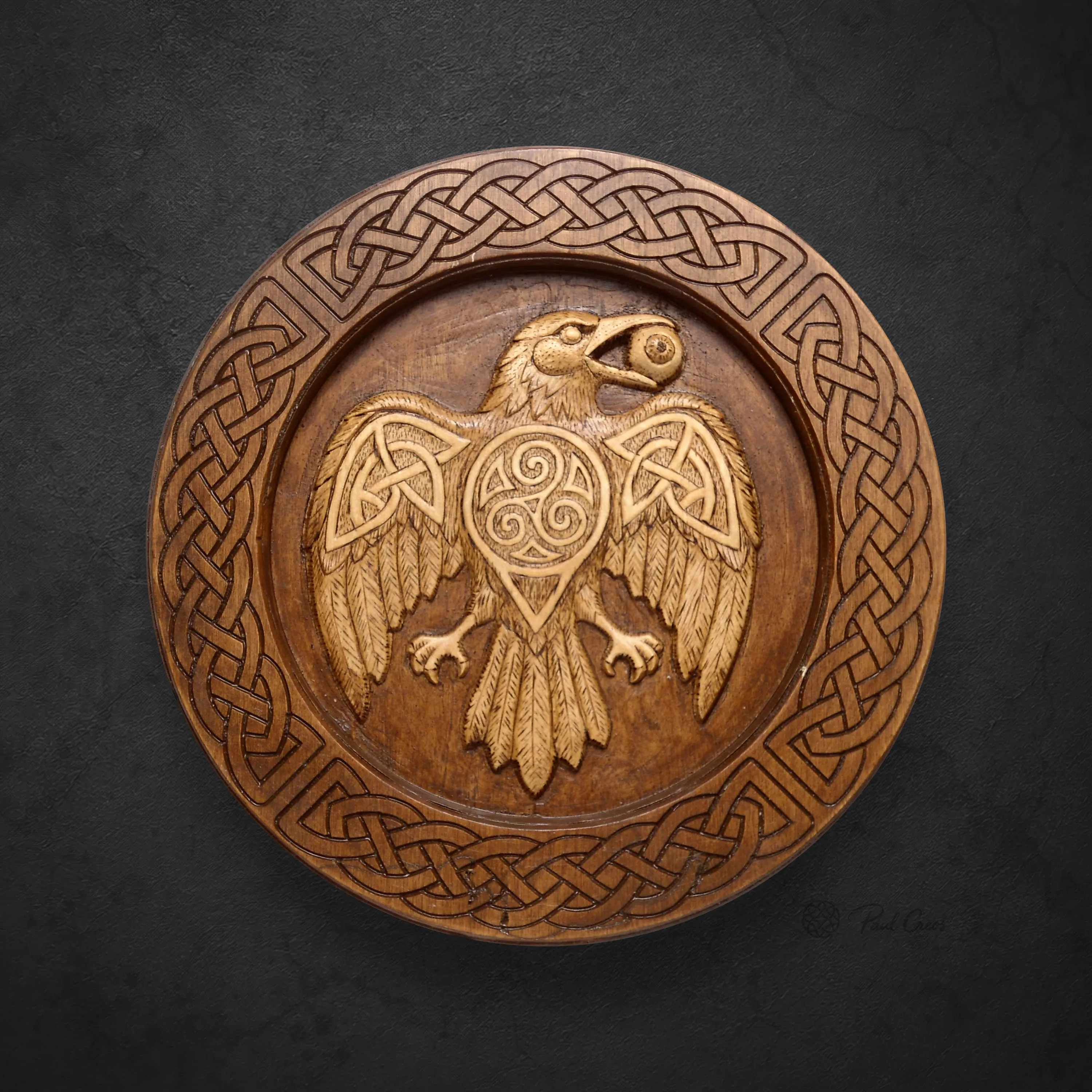
This is where the historical image becomes my own work. Raven Warden is a contemporary wooden interpretation of the raven as observer, messenger, and guardian of memory. It stands as a new piece shaped by older stories, the living landscape, and personal symbolism, rather than as a reconstruction of an archaeological object or a claim about an exact historical Druid image.
Wood gives the raven another kind of memory. Every tree records years of growth, weather, injury, and recovery. Its grain holds a history that can be read in rings, cracks, knots, and changes of texture. When the wood becomes the form of a raven, two kinds of memory meet: the memory of the tree and the memory carried by the bird.
The Raven Warden is imagined as a presence at the threshold. It watches without panic. Its stillness is not passivity; it is concentration. It belongs to the moment before a message arrives, and to the quiet after something has ended.
Each wooden piece is allowed to remain individual. The grain, the marks of the tools, and small variations in the surface give every raven its own character. One may feel like a keeper of the doorway. Another may seem more like a messenger or a companion beside a personal place of reflection.
Placed near an entrance, the Raven Warden watches the threshold. Beside a hearth, it can stand close to family stories and the memory of those who came before. Near a desk or workshop, it can remind us to observe carefully before acting. Its meaning grows from the form and from the place where it finds a home.
The black bird of the old stories carries images of battlefield, grave, forest, and sky. In wood, these images become quieter. The raven need not threaten the room. It can simply remain there, attentive to what enters, what leaves, and what deserves to be remembered.
The Raven That Remains
The raven resists a single meaning. It is a bird of battle and death, as well as prophecy and protection. It belongs to Badb and the Morrígan, to Brân the Blessed, to the high view of the sky and the deep memory of the earth.
It reminds us that every decision leaves a trace. Places remember through names, stories, bodies, trees, and the people who return to them. What disappears from sight does not always disappear from the world.
This is the raven I carve: a presence between what is leaving and what is approaching, between the message not yet understood and the memory that refuses to die. A guardian that looks into the darkness with clear attention.
Perhaps one day a raven will cross your path, settle in a tree near your home, or remain on a wooden shelf beside the place where you keep your own stories.
Some messages do not arrive in words. Sometimes it is enough that the raven stays nearby, and that we begin to look more closely.