At night, a small movement appears beside the lamp.
A moth circles the glass, disappears into the darkness, and returns a few moments later. Its body looks fragile, yet it survives in a world that human beings experience as hostile. It moves between shadow and light, concealment and exposure, the life we recognise and a form we have not yet learned to understand.
The moth is easy to overlook during the day. After sunset, it appears beside a window, a fire, or a candle, and suddenly becomes part of the room. Its presence can feel like a message from outside the human world.
Moths are often given a fixed place in modern “Celtic symbolism”: souls of the dead, guides between worlds, or signs of approaching transformation. The historical evidence is more limited. Celtic and Irish sources do not give us a single doctrine of the moth, and ancient writers do not describe it as a clearly defined sacred emblem.
There is, however, one important Irish story involving a transformed winged insect. It gives the moth a genuine point of contact with medieval Irish literature, while also showing why we should be precise about the source.
Étaín and the Purple Fly
In Tochmarc Étaíne, The Wooing of Étaín, the woman Étaín passes through several transformations. After being placed under a spell, she becomes a pool of water, then a worm, and finally a purple fly — cuil corcrai in the Irish text.
The fly is unusually large and beautiful. Its voice is compared with music, and Midir, who loves Étaín, carries a sun-bower so that she can remain close to him. Later, a storm scatters her, and she wanders for seven years before falling into a cup of wine. The drink is swallowed by a woman, and Étaín is eventually born again as a human child.
The story is preserved in medieval manuscripts, including Lebor na hUidre and the Yellow Book of Lecan. The Corpus of Electronic Texts at University College Cork preserves the edited Irish text and identifies the transformed creature as a purple fly.
This detail matters. The Irish word cuil means a fly, not specifically a moth or a butterfly. Later readers may imagine a butterfly, dragonfly, or moth because the image is more visually familiar and fits modern ideas of transformation. That can be a meaningful creative interpretation, but it should not be presented as a literal translation of the story.
What the tale genuinely offers is a powerful image of a person who survives through radical changes of form. Étaín does not simply become more beautiful or more powerful. She is separated from her former life, carried through a long period of uncertainty, and eventually returns in another body.
The moth belongs naturally beside this image, even though it is not the creature named in the text.
A Creature of the Night
The moth belongs to darkness, but light draws it near.
During the day, it may disappear among bark, leaves, dry grass, or the shadowed corners of a house. Its wings can resemble fragments of wood, dead leaves, or lichen. When it stops moving, it can become part of the surface on which it rests.
At night, its world changes. It moves between plants and flowers, follows scent and temperature, and sometimes enters the human circle around a lamp or candle.
This creates a tension that makes the moth such a strong modern symbol. Light can offer direction, but attraction is not the same as safety. A flame can guide a moth towards warmth or draw it into danger. The moth does not possess a human explanation for the light; it responds to a signal within its own world.
For a person, this becomes a question about discernment. We may be drawn towards knowledge, love, certainty, or a new purpose with such force that we stop noticing what the attraction costs. The moth does not tell us to avoid the light. It asks us to approach it with attention.
The Cocoon and the Hidden Interval
The moth’s life cycle gives the symbol another layer. It begins as a caterpillar, moves through the world close to the ground, and then enters a protected enclosure. For a time, the outside world sees very little. Something is changing in darkness.
When the adult moth emerges, it has a different body and a different way of moving. The transition is not a simple improvement from weakness to strength. It is a passage through an interval in which the old form has ended and the new one has not yet become visible.
This is one reason the moth speaks so clearly to periods of personal change. A person may have already left an old identity while still lacking a clear shape for the next one. From the outside, that period can look like stillness or withdrawal. Within it, an unseen process may be continuing.
The cocoon is not an answer. It is a time in which answers are being formed.
Soul, Death, and Folklore
In Irish and British folk traditions, butterflies and moths can become associated with souls, death, dreams, and visits from beyond the household boundary. These beliefs vary by region and period, and they should not be turned into a single Celtic teaching.
The distinction between moth and butterfly was not always the same as the modern scientific distinction. A pale winged insect entering a house could therefore be interpreted through an existing language of spirits, omens, and the return of the dead. A white moth might be welcomed as a soul or feared as a sign of death. A darker insect could be connected with illness or misfortune.
Such beliefs reveal how people responded to the animal’s behaviour and appearance. The moth arrives at night, makes no human sound, and can appear suddenly in a private room. It crosses the boundary between outside and inside without being invited.
The historical record does not allow us to say that every Irish household understood this visit in the same way. It does allow us to see why the moth could become a figure of memory and transition.
Samhain and the Modern Imagination
Modern Druidry and Pagan practice often bring the moth into the atmosphere of Samhain: the season of darkness, harvest’s end, and remembrance of the dead.
The association is understandable. A moth appears near candlelight as the year turns towards winter. It belongs to evening, quiet houses, and the feeling that a familiar boundary has become less solid. It can represent a memory returning, a life cycle closing, or an ancestor whose presence is felt rather than seen.
Yet there is no evidence for an ancient Celtic system in which the moth was a fixed symbol of Samhain. The connection belongs to modern interpretation, built from the moth’s real behaviour, later folklore, and the wider meaning of the season.
This does not make the symbol weak. It makes its history clearer. A living spiritual path can create new relationships with the natural world without pretending that every contemporary image was recorded by ancient Druids.
Shadow and the Unseen Self
The moth moves through the parts of experience that daylight tends to push aside. It can therefore become an image of the shadow: memories, fears, desires, and questions that wait until life becomes quiet.
The shadow is not necessarily evil. It may contain knowledge that has not yet been brought into conscious life. The moth’s colouring often helps create this impression. Browns, greys, blacks, creams, and muted whites allow it to disappear into ordinary surfaces. Its hiddenness is rarely theatrical. It is subtle enough to be missed.
Inner life often behaves in the same way. A recurring dream, an unexplained reluctance, or a feeling that appears without a clear cause may remain unnoticed until we slow down. The moth asks for a slower gaze.
It does not force the hidden thing into the light. It shows us that the hidden thing is already present.
The Moth in Modern Druidic Symbolism
There is no surviving Druidic handbook that defines the moth’s meaning. The modern practitioner must work from observation, folklore, literature, and personal experience.
In that practice, the moth can accompany:
- a transition between stages of life,
- work with dreams and the unconscious,
- remembrance of the dead,
- acceptance of one’s shadow,
- a search for direction in uncertainty,
- the patient growth of a new identity,
- and the need to distinguish true guidance from dangerous attraction.
The moth offers a quieter image of transformation than the butterfly. It does not usually arrive in bright daylight. It carries the colours of bark, soil, smoke, and dusk. Its transformation is connected with concealment, persistence, and the courage to continue without being seen.
Moth and Wood
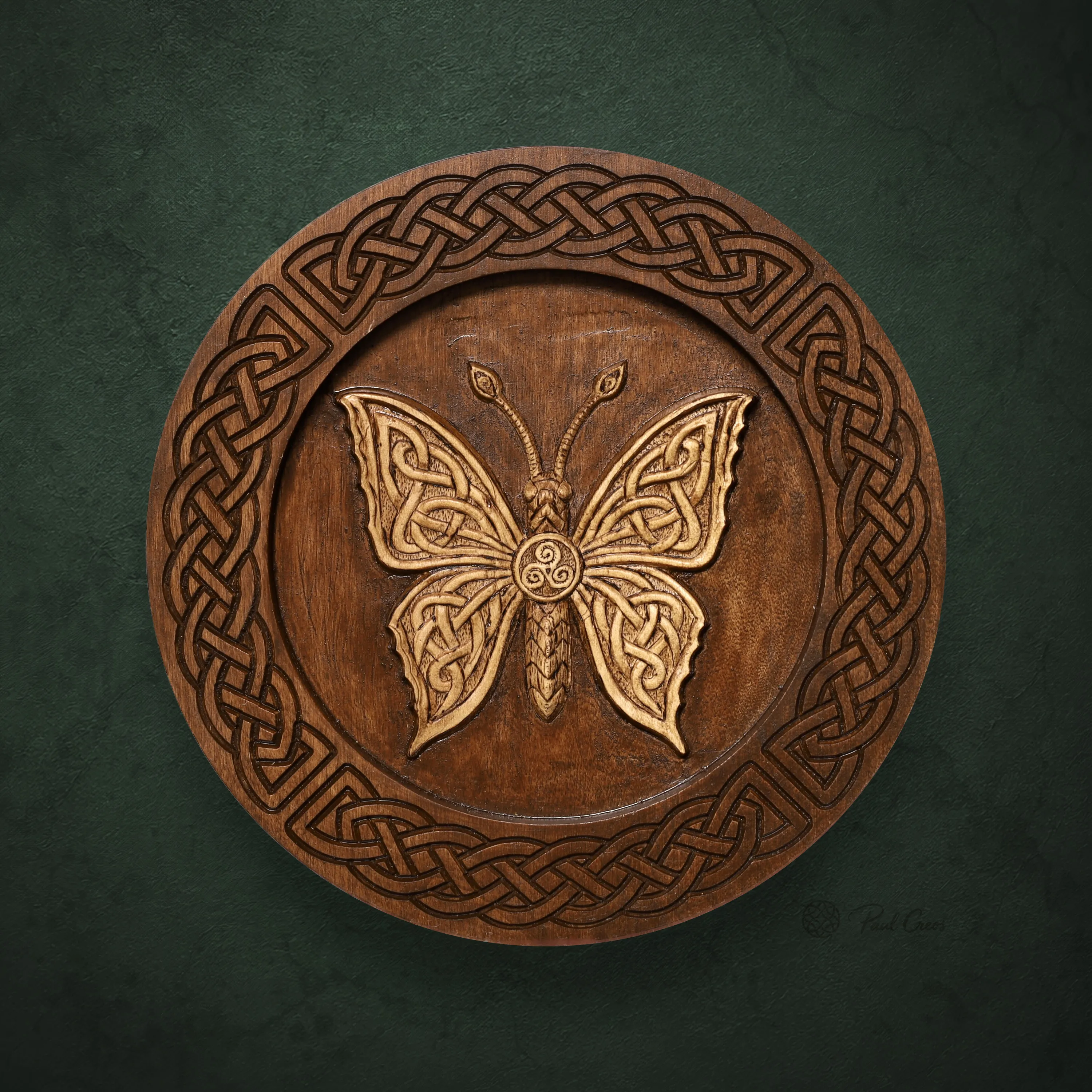
Wood may seem distant from such a delicate creature. It is solid, heavy, and marked by years of growth, while the moth is light, mobile, and short-lived. That contrast gives the image its strength.
Wood preserves time. The moth embodies a moment of change.
When a moth is carved into wood, a brief movement through darkness takes on a lasting form. The wings remain still, yet their pattern continues to suggest flight, heat, night, and the pull of light. Grain and wing markings can enter into conversation: the tree’s long memory meeting the insect’s passage through transformation.
A wooden moth may belong beside a window, a candle, a bed, or a place where someone works with dreams and memory. It can mark a threshold without claiming to explain it.
What the Moth Teaches
The moth does not offer a simple promise of rebirth. The story of Étaín is not a neat lesson about becoming a better self. It is a story of disruption, separation, endurance, and return through a body no one expected.
That makes the moth a fitting companion for difficult change. It reminds us that transformation can be lonely and that the hidden interval has its own value. It also warns us to examine the lights we follow. Some forms of attraction lead towards understanding; others merely keep us circling.
The moth moves between the two questions without resolving them:
What is calling me, and what is it asking me to become?
In the darkness, the answer may not arrive as a clear sign. It may begin as a small movement beside the lamp, a return of an old memory, or the recognition that something inside us has already changed.
The moth has been given many meanings in modern Celtic-inspired spirituality. The historical evidence is narrower, but it is not empty. Étaín’s purple fly gives us a genuine Irish story of transformation through an insect form. Folklore gives us the image of a winged visitor crossing the household boundary. Nature gives us the real cycle of concealment, emergence, night flight, and attraction to light.
Together, these layers allow the moth to become a living symbol without pretending to be an ancient fixed doctrine.
It remains between shadow and light, between the form that has ended and the one that has not yet appeared. And in that uncertain space, it keeps moving.